




Latest News
Jefferson County Drinks with Dems!
Thursday, May 14, 6-7 PM
Stable Rock Winery, Jefferson
Learn How to Deep Canvass
Saturday, May 16, 9am – 3pm
Lake Mills
Trivia Party in Support of Representative Brienne Brown
Saturday, May 16, 5 PM
Henry St. Social, Edgerton
May Membership Meeting
Tuesday, May 26
Centennial Park, Johnson Creek
Intern with the JeffDems
Now accepting applications for Communications & Social Media, and Business Analyst Internships.
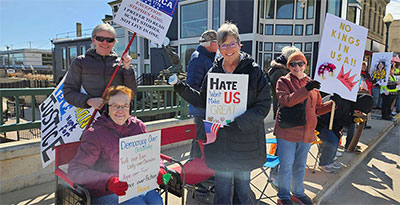
Fort Atkinson Weekly Protest
Every Wednesday, 3:00 – 4:30 pm
New Location: McCoy Park
Recent Facebook Posts


Spent some time yesterday chatting with this fun group of third graders at Purdy Elementary. Rep. Brienne D. Brown and I shared information about our jobs in the State Assembly and answered all kinds of questions about our work day. As they explore future careers, I’m happy to have been invited to share our experiences in public service. ... See MoreSee Less
Photos from Wisconsin State Senator Melissa Ratcliff's post ... See MoreSee Less
There are some big claims going around about the bill that Governor Evers and Republican legislative leaders tried to push through the legislature at record speed, which failed due to bipartisan opposition last night. So let’s break it down:
While this bill included some additional special education reimbursement that our schools need, it still failed to guarantee reimbursement at a certain percentage, meaning it wouldn’t keep pace as special education costs rise. We already saw how this played out with the most recent state budget – politicians made promises to schools and those promises were broken as funding fell short. It’s important to be honest about the numbers and not make false promises to our schools about what money they will and won’t be able to put to work in classrooms.
The bill was touted as $600 million for schools – which was less than half of the bill’s total cost – but that number was not right. The bill would have provided $315 million in spendable money for our public schools, which wouldn’t have been nearly enough to stop layoffs or to prevent the need for more referendums.
The remaining $302 million – less than one fifth of the bill’s total cost – would have passed through the schools to provide property tax relief. Property tax relief is a top concern I hear about from my constituents, but this bill would give the owner of the median-valued home in Wisconsin just $107 in 2027. Most homeowners in our Senate district would have gotten even less. The proposal was not the guaranteed, long-term funding that our schools need or the true property tax relief that people are asking for, but if it had spent only the $617 million to do both of those things, I could have supported it. Unfortunately, the total price tag of the bill was over $1.8 billion, dwarfing the amount of money going to schools and property taxpayers.
You may have heard that you’d get a $300 or $600 rebate if this bill passed. But depending on a number of factors, that may not have been true, even though the rebate would have spent $850 million that we may not even have. One thing that is true - millionnaires and billionaires would almost certainly have gotten their rebate check. But the best estimate is that 1.36 million adult Wisconsinites – one out of three – would have been left out and not qualified for this rebate - in particular families with children, people with disabilities, and seniors on fixed incomes.
You may have heard that the state has a multi-billion dollar surplus and that’s how this package would have been paid for. But that’s also not fully true. Much of that surplus only exists in on-paper projections. The state doesn't have the money yet. In an economy where we have a stock market that is propped up by AI speculation, where gas prices are through the roof, and businesses are slowing growth because of economic uncertainty caused by the federal government, Wisconsin would need the kind of economic growth that we cannot count on in order to avoid new cuts to basic services or raising taxes in the future just to cover the cost of this proposal. If this bill passed, Wisconsin could have faced a $2.9 billion deficit by the end of the next state budget.
In short, this bill didn't do nearly what we truly need to fund our schools or cut property taxes. Instead it tried to spend nearly $1 billion that we don’t really have on a one-time tax rebate that was not targeted at the people who need help the most, and 31% of adults in Wisconsin would not have received.
This is the kind of lame-duck election-year gimmick that could only have been negotiated behind closed doors by 3 people who will never face voters again. While there are individual parts of it I support, on the whole it’s a bad deal for Wisconsin and I couldn’t support it. Members of both parties saw that the proposal would have led our state in the wrong direction, which is why it failed in the State Senate on a bipartisan vote.
We have to think sustainably, and we can. There was no need to end this discussion last night. Senate Democrats have been clear that we want to work towards a sustainable deal that is fiscally responsible and gets help to our schools and the people who need it. Now isn’t the time to be giving the ultrawealthy a handout. Now is the time to work together to help our schools and Wisconsin families who are struggling. I will keep fighting to do that. ... See MoreSee Less