
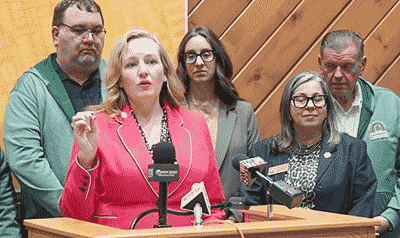
FOR 2026
I have every reason for us to feel hopeful. Our resistance and our action, and those of the incredibly brave neighbors in Minnesota, are making a difference. We are seeing Trump retreat, we are seeing the faltering of their coalition, Republicans are breaking off, so we have to take a lot of hope and heart from that. Our actions and the actions of like-minded Americans all across this country are making a difference. And they’re going to power exciting electoral victories in 2026. If we don’t screw it up.
So I’m really happy to be here with you, and I also want to apologize for not bringing any of my kids tonight. When I was here 8 years ago running for governor, I did have my campaign baby with me. She declined the invitation tonight. She would rather stay home and read by the fire on a cozy winter night.
I’m running for governor for 2 very simple and important reasons. Number one, we need our strongest and most courageous candidate to stand up to this authoritarian regime. We need a governor who is willing to use every single tool at her disposal to protect Wisconsinites from the many harms of the Trump administration and the Republican allies, including Tom Tiffany. And I’m talking about, obviously, ICE and the brutal violence that they have brought down upon communities, but I’m also talking about the economic harms to businesses, to farmers, to ordinary working Wisconsinites in our pocketbooks. There’s a lot that we can do if we have a strong governor to resist and to help renew our broken democracy.
The 2nd reason is because as scary a moment as this is in our country, it is also a moment of real opportunity that we have not seen in Wisconsin for a generation. We are on the cusp of having a Democratic majority in the Wisconsin State Senate, something that I have worked very, very hard to do since my election to the Senate in 2020. We are going to take the state Senate, and the assembly is going to be close enough, one way or the other, but we’ll have room to maneuver. But only if we have a Democratic governor who comes into office knowing exactly what she wants to do, who has the skills and the political capability to get it done, and is willing to spend the political capital, exercising political power to get it done.
It’s a narrow window of opportunity, and we have to be willing to seize it. And that’s what I’ve basically been working on throughout my whole career. For 25 years, I’ve been traveling around the state in various capacities working to build Democratic power and achieve progressive legislation. And I’ve been able to do that in every type of legislative environment.
When Democrats were in control, it was my very 1st term in the Assembly in 2009. That’s the last time we had a Democratic trifecta. And we did a lot of great things. As the vice chair of the Committee on Health, we expanded badger care to 80,000 previously uninsured Wisconsin. We added protections for LGBTQ Wisconsin. And those were great things, but there was a lot that we left undone.
And then, of course, in 2011 came Scott Walker and his attack on Wisconsin workers and families. And I was there for that too. I wore a very unflattering orange t-shirt, and I moved my desk out onto the frozen ground of the Capitol when they tried to lock out the people to silence our voices.
So I feel a deep sense of purpose in this campaign and in this moment, to make sure that we have our most capable and courageous leader as governor. So that we can make the transformative change that our state needs and deserves. So what are the things that are at the top of my agenda?
It’s really 3 very simple ideas:
- We need to raise wages.
- We need to lower costs,
- and we need more freedom.
Going into a little more detail in each of those, raising wages, we’ve got to raise the minimum wage. $7.25 an hour is not enough to cut it. It wasn’t even enough to cut it when we passed it almost 20 years ago. I believe we need to move to a $15 hour minimum wage, and we need to have a path over time to get to $20 and restore local control so that local communities can set minimum wages that meet their communities. But we also have to restore collective bargaining rights because that is one of the most powerful ways that we can put more money in the pockets of working people, whether in a union or not. We all benefit from collective bargaining.
In terms of lowering costs,
I’m thinking really of the biggest ticket items, like housing, healthcare, childcare, prescription drugs, utilities. The things that are necessary, but really break the bank for people. And I have detailed plans on all of these because as I said, I’ve been doing this work for a long time. I’m the only candidate with detailed state budget experience for my time on joint finance. I know where the money is, and I know where it needs to go.
And one big place it needs to go is our public schools. Our public schools have been starved of funds for 30 of the last 32 years by Republican legislatures. So if you’re talking to your neighbors, or you’re pulling out your property tax bill, you don’t like what you see. There’s one reason. There’s one person to blame, and that is the Republican legislators who have been defunding our schools and local communities for generations, and sticking the bill to property taxpayers.
So as government funding of public schools is going to be a key priority of mine, as well as bringing the voucher scheme to a responsible end. We simply do not have the money to be shipping taxpayer dollars to these unaccountable schemes that are allowed to discriminate against teachers and kids that don’t have to follow the same rules that our public schools do, and that don’t have the accountability and the transparency that we need.
In terms of freedom,
I spent four years as the executive director of Naral Pro Choice, Wisconsin. So I will be unwavering in my commitment to defend everybody’s right to control their own body, their own healthcare, and their own future. That’s incredibly important to me. But I think of freedom more expansively. It’s really about the freedom to thrive. The freedom to start a small business, which is something I had the opportunity to do 13 years ago after I left the state assembly.
I started a small business that aimed to make it easier and more affordable for people to buy and sell houses. And we’ve helped save Wisconsinites nearly $2 million in real estate fees. And I’m really proud of that because homeownership is a really important way that Wisconsinites can build well. We’ve got to make housing more affordable. We’ve got to build more housing, not just apartments, but condos and townhouses and single family homes that are actually affordable for Wisconsin nights.
In terms of healthcare,
right now, how many of you get healthcare through a job through employment? Right. And how many of you know someone that has made decisions about their life because they were tied to healthcare benefits from their job? Like they delayed retirement, they didn’t go back to school. Um, they didn’t move or take a different job or start a business. The current way we do healthcare is unaffordable, and it’s making us all less free.
My plan is very different from what the other Democratic candidates are offering.
Listen, I’ve been fighting for Medicaid expansion for 15 years, but that is not a healthcare plan. And unfortunately, because of the federal budget bill that passed this past summer, Medicaid expansion is not really a feasible option for Wisconsin. And it isn’t responsible for our candidates to be campaigning as if it is. So I’m just going to tell you straight.
Medicaid expansion is not going to solve our problems, and it wouldn’t have even if we hadn’t expanded it years ago, which we should have done.
My plan will open up the state health insurance program, the same health insurance that I enjoy as a state senator, to allow anybody to buy in. So an individual could buy in, a small business, could buy in, a union or a local government unit, or even a big manufacturing company that just doesn’t like having, you know, 5th year of double digit increases from their for-profit insurance company. And by the way, we can do the same thing with the Wisconsin retirement system. We can allow people to voluntarily buy into a secure retirement. And again, you have to pay your fair share just like I pay as a state employee. If you’re an employer and you want to say it, oh, you’ll have to pay the employer share. But we can give people more freedom by expanding these great public programs that public employees have access to.
I’ll just close by giving you a couple fun facts about myself.
Although I represent Dane County and the legislature now, and I’ve represented urban, rural, and suburban communities, very diverse communities during my time in the legislature, 10 years of service in the legislature. I was born in Marshfield, and I spent my early years in rural Taylor County, north of Highway 29. And when I say rural, I mean, I grew up in a one room schoolhouse and I had a pet goat.
So, I think at this moment, we need a candidate who does a couple different things. We need a candidate who can connect to all voters across the state, no matter who you are or where you’re from. A candidate who can speak with respect and really hear what the Baldwin-Trump voters are about and care about what the Evers-Johnson voters care about. We need a candidate who is not afraid to go into hostile places, places the Democrats perceive as hostile, isn’t afraid to answer questions, and isn’t afraid to connect with people who might be different. I have a really strong track record of doing that as an organizer, as a lawyer, as a small business owner, and a candidate.
And it’s just a committed democratic volunteer like all of you going to connect with people who are different. We also need someone who can win the primary. Because we could end up with a situation with so many candidates. We could end up with a nominee who makes it harder for us to win a general election. This is not going to be a gimme in 2026. We could screw this up.
We lose elections in the state routinely. And we shouldn’t get copied. Listen, in 2018, when Evers squeaked by and thank goodness he did, Democrats had a 7 point ballot advantage in 2018. It was enormous then. Today, the generic ballot advantage for Democrats is not 7%. It’s four. So we have to think long and hard about who we nominate as our candidate.
And I would submit to you that because of the work I’ve done, I am certainly the most experienced candidate running for governor. I am prepared to govern. I don’t need to wait for a poll to tell me what to think. I’ve been fighting for these issues my whole career. But I’m also the strongest candidate who can win the primary and the general. And that’s because we have a lot of good candidates. But they’re from Milwaukee, and they’re gonna be splitting up that Milwaukee vote share.
And I’ve got a really strong base here in South Central Wisconsin in Dane and Jefferson County, which is a vote rich area. So if I can unite you and your neighbors behind my candidacy early, we can guarantee that we don’t split that vote and end up with a nominee that’s going to make it harder for us to win.
Because at the end of the day, the most important thing is that we protect our state from having a tiny trump in Tom Tiffany. Thank you so much for having me, I would love to answer the hardest questions that you can muster.
Q&A
Q1: Yeah. you had mentioned something about collective bargaining and overturning or getting rid of that. How would you expand that? Where do you go beyond teachers? And if so, who? What group?
A1: Yeah, I mean, Act 10 attacked all public sector employees with the exception of some public safety unions. Listen, I believe that everyone, public or private sector, if you want to form a union and collectively bargain, you should have the right to do it. And after Act 10 was passed, the next thing that Walker did, this was part of his dividing conference strategy, was he went after the private sector unions.
So if you’re a bricklayer, if you’re a painter, if you’re a nurse or a teacher, that shouldn’t matter who you work for. If you want to be part of a union, that is, I believe, a fundamental right. It’s about your right to organize and your right to associate and have that union be your voice. And so I believe in restoring those rights, that means overturning the right to work or storing prevailing wage, all those kinds of things.
But more fundamentally, we should allow cross-sectoral bargaining, right? So that if you work in a field like childcare or home health, where you might just have one or 2 or a few people in one site and are traditionally low paid and don’t have a lot of benefits, you could basically create solidarity with other workers at other job sites and form a collective union.
So there’s a lot that we can do to revitalize and strengthen collective bargaining. And I think it’s one important piece of making sure that we have an economy that works for everybody.
Q2: So with so many candidates, you can’t really, the way it’s set up, you can’t really kind of coordinate with other candidates to say, let’s team up, and I can make you lieutenant governor, because we already have a lieutenant governor candidate, and carved out that position. How is it working with other candidates, huh? Yeah. With so many candidates. How is that gonna work out?
A2: Well, listen, I’m a team player. I believe that politics is a team sport. And we need every single person in this room, every single candidate that’s running for governor is a good person and they have something to offer and we need that. And I’m committed that if I am the nominee or if I am the governor, I want to make sure that everyone who wants to be on our team gets to be on our team. And it’s not just talk for me because in 2018, you know, I ran for governor.
I had been out of politics for 6 years. I was in the assembly for 2 terms and then retired from politics for 6 years. And I had my baby and my toddler and was traveling around the state. And the day after I lost the primary to Governor Evers I called them that night and I conceded and I offered my support. And the next day, I got on the phone to my biggest donors, and I raised over $60,000 for the governor in those intervening weeks.
I traveled the state for him, to campaign for him. I asked my supporters and my volunteers to do that because at the end of the day, we have really, really important priorities that must get done. Now, I believe I’m the strongest candidate to win the primary and the general.
I believe I am best prepared to govern. I certainly have the most experience in and around state government. I know how to get things done in every legislative environment. I think that’s going to be essential if we actually are going to seize this once under generation opportunity to make change. But I am fully prepared to do everything in my power to make sure that we elect Democrats up and down the ticket.
And by the way, I’ve done a lot of work electing the Supreme Court candidates. Do we like our new Supreme Court? I do. And I’m ready to give them a better breakfast, because my friend goes there.
Q3: These school vouchers? How does that work? Is it straight from the property tax, or is it from the state? ‘Cause I like to see it out of property can’t build how much money it’s going to work for… Yeah, seeing it on a property tax bill has got to be step one. I mean, that is low hanging fruit, and Green Bay is doing it, and other communities are looking at that.
A3: People would be shocked if they knew how much money was going to vouchers. It is millions of dollars. And you can really track how school funding has declined and the voucher program has increased. The way it works is it comes directly out of the general fund for your local public school. So it’s just like a giant claw machine that takes the money out and gives it to the vouchers. And by the way, I mentioned they can discriminate against kids. If they have a kid that they accept after 3.5 weeks, they decide they don’t want that kid. They can kick him or her out and they keep the money that went with that kid. And they don’t have to take special ed kids but when they do, do you know how much the state reimburses for the cost? 90%. Do you know how much our public schools get? 38? About, it’s roughly 35%. The budget promised it would be 42 and 45. That’s the budget deal that the Evers administration made. But because they didn’t allocate enough money, they limited the amount of money. The actual number is closer to 35%. That is shameful. absolutely shameful. So, yes, I’m the only candidate that not only has spoken out clearly against vouchers, but I actually have a plan to responsibly bring it to an end.
Q4: Is there, um, what plan do you have, cut into the damage that’s been done by Steve Nass, and his cronies to and destroy the university system as a Freethinking entity?
A4:Yeah, the University of Wisconsin is the greatest economic engineer for the state. And the way that Republicans have taken an ax to it is extremely detrimental.
It is harming our economy and it’s hurting our ability to keep young people here in the state. We’ve basically said, please get out of here, a sign to the best and brightest young people in the state. And when they leave, it’s hard to come back. I mean, I did. I went away for college. I came back to law school at the University of Wisconsin. And then I ended up entangled here and here I am, you know, 25 years later. But we lose too many people and too many young people never have the opportunity for public higher education because the cost is too high. So my plan is to do a couple of things.
Number one, it will put back the money, the millions that we stole from the universities of Wisconsin.
Number two, it will restore autonomy to the university. There is no way that politicians should be dictating what professors get hired, what students get admitted, what passes are taught, what books are in the library? I mean, come on, do we live in a free country? We ought to. We ought to. I mean, I don’t want the government in the doctor’s office. I don’t want the government in the library, look into what books you check out. We all deserve access to information and education. It is the foundation of a democracy.
And then finally, I’ll say, We ration education in this country, in the sstate, based on the wealth of your family. And that’s pretty dumb. Because we all have a stake in making sure that every young person has the opportunity to thrive, to be the best version of themselves that they can be.
And if that path takes them to the military, great. If it takes them to the trades, wonderful. If it takes them to one of our great technical colleges or a private university. Wonderful. But for so many young people in Wisconsin, their door to higher education, their career path has to go through the University of Wisconsin.
We have lost 6 campuses, 6 UW campuses in the last couple of years. Needlessly, it was a choice that Republicans made. And we’ve made it more expensive to go to college.
I will expand Bucky’s tuition promise that states that if you and your family earn the median income in Wisconsin or less, that you will go to one of our campuses, tuition free, as long as you can get in, you’re ready to do the work.
Then you can go for free. Right now, it’s just in Madison, but we should expand it statewide. We should be opening doors about how we support young people.
Q5: Yes. Can you, uh, talk about voting rights, and protect the whole voting system that’s under attack by the Trump administration?
A5: Yes, there is a lot that we can do to protect our elections, and the most important thing is to keep partisan interference away.
I believe that voting is a right, not a privilege, and we should expand options for early voting, for voting by mail. We should reduce the barriers to voting, things like voter registration.
And more fundamentally, we have to change the way that voter ID works in the state. Right now, it is implemented as a barrier. Now, I was against voter ID because we don’t have a voter impersonation fraud problem in this country. We just don’t. But, you have to have such a specific form of ID. We should just say basically any photo ID, but the driver’s license from another state, no problem. If it’s a passport or a military card, no problem.
If it’s a student ID, great. Any ID, even if it’s expired, should suffice. And we need to restore provisions that were taken away about special voting deputies, registration deputies that went into high schools to help young people register to vote. There’s a lot of stuff that we can do to make voting easier and more accessible. More broadly, though, I think the biggest challenge, one of the biggest challenges that we have in our democracy, is that a lot of people just feel like it doesn’t matter who they vote for. The government doesn’t deliver for that and things don’t change. They don’t feel heard and they don’t feel represented.
And that’s a problem for governors, people who want to be in elected office if we’re not delivering for people. So making state government work better for people is going to be a big priority for me because it’s important that everybody deserves a good government, but it’s important to bring people back into the process and get them to engage.
We also need to, I think, expand options for people to make their voices heard. So innovations like fusion voting, ranked choice voting, we should absolutely be doing that in Wisconsin to give people a feeling that they actually are able to vote for a candidate that they want without spoiling the election. They’re able to make their voices heard.
And finally, you know, right now we’ve got the best democracy money can buy. I mean, I spent a huge amount of my time not thinking deep thoughts about policy, although I’ve certainly done a lot of that over the years. But I call people and have conversations and then ask them for money. And that’s because I don’t have Elon Musk in my back pocket. In fact, I called for him to be arrested for violating election bribery law.
If I post on Twitter, you’re not going to see any engagement. My engagement has gone to 0 on Twitter. I wonder why.
We need public financing of our campaigns. We need to make it possible for anybody to run for office, and we need to have full transparency and end these dark money schemes that funnel huge amounts of money and swamp our elections and even swamp candidates in what they raise. Those things, I think, will restore some confidence in our elections and will help people feel more like they have a stake in our democracy.
Q6: You are a parent, what gives you hope?
A6: A lot of things give me hope, actually. The conversations that I have with people in every part of the state. As you know, I’ve traveled everywhere. I’ve traveled recently, just in the last, you know, a couple days or weeks, to Marinette, to Trump areas, to Ozakee, to some of the reddest parts of the state, and people are fired up.
I have stood with Wisconsinites in weather like this, out on street corners, in small towns that voted 70%, 80% for Trump, and watched them as we walked. That gives me hope.
Another thing that gives me hope is that it’s working. What we are doing is working. And I think that we don’t have another choice, but to keep doing what we’re doing. Because if we give up, then they have won and that’s what they want.
And there’s not a single person in this room. that is willing to give up and trade what is good and great about this country and our drive to make it better, which is fueled by patriotism and love of country. Not a single one of us would give that up. And so that’s how I know that we are going to win. It’s just a matter of how long it’s going to take.
Q7: So, if you become a governor, what is your plan to keep communities safe, um, from ICE or border patrol or a military or national guard coming here? Because now that’s not being talked about. And that needs to be a solid plan because that is happening everywhere.
A7: Well, I know not everybody’s talking about it, but I’ve been talking about it a lot and I’ve been talking about it for more than 10 years. ICE is incompatible with a free society. Today’s ICE cannot stand in a free society.
They are a violent paramilitary force, accountable to just one man, and they are visiting untold violence and destruction in our communities. ICE is making us less safe and less free and the only answer is for us to defund it, to dismantle it, to abolish it, and to start anew.
It cannot be redeemed after being supercharged by Trump. So one thing that I would just ask of you, if you haven’t already, please call Ron Johnson and Tammy Baldwin. Thanks, Senator Tammy Baldwin, for saying that she will not vote on this funding bill. Unless we get rid of these ICE deployments, these violent raids that are assaulting our cities. And of course, as we always do, Spank Ron Johnson, who should not be in the Senate, we should have been able to beat him and get rid of him, but next time you will.
Because that is actually a live issue right now, that we can have an impact on that. We are very, very close. We don’t need every single Democrat. We just need most Democrats to say no to stop this.
Secondly, months ago, last fall or last summer, I introduced a package of bills, along with other Democrats, to stop the masks and anonymous kidnappings and law enforcement actions that were happening to prohibit our local government, law enforcement resources from being diverted into immigration enforcement. Because I think our local law enforcement resources should be going to our public safety.
And not to terrorize communities of ripping families apart. So I’ve been on this for a long time.
Another piece that I think is essential and I continue to push for is civil and criminal liability. for ICE agents and others who violate our laws. Listen, Donald Trump can say all he wants that you’re immune, but you ain’t immune. You are subject to the Constitution. You’re subject to federal law. You are subject to our state constitution and to our state laws when you are operating in Wisconsin.
And I think that the thing that will really turn the tide is when there is legal accountability. A big part of the reason that we’re in the mess we’re in right now with our democracy on the brink of living under this authoritarian regime. is because we did not hold Donald Trump and his enablers fully accountable for their assaults on our democracy. So that’s going to be a big priority for me. Finally, I think there’s a lot of strength in numbers. And so one of the big important tasks that our governor is going to have is to cooperate and plan and strategize with other governors.
So I was glad to see that Governor Evers finally joined the lawsuit. that Minnesota and Illinois put forth to get ice out of our communities. I had urged the attorney general to sign on to an amicus brief, which he decided to do. And we have to do everything we can. We haven’t faced this before in this exact way. And so I think we do have to be creative. We have to be strategic. We have to look at the situation on the ground and really be using every tool at our disposal to try to protect people and have public safety.
And finally, I’ll just say, listen, I’m a lawyer. I believe in the role of law. I don’t think we should have laws on the books that were not enforced. But we don’t need ICE to have secure borders. As I said, they’re making us less safe and less free. We did just fine before ICE.
We had, you know, customs and border protection. It was all done through INS. We can have safe communities, and we can hold accountable anybody who commits crimes and hurts people with our criminal justice system. And if needed, after they have served their time, we can deport them. But you don’t need to do it while endangering every single person in this country.
Q8: How do you think you’ve changed as a candidate since the last time you ran for governor ?
A8: Well, I’m getting a little more sleep than I was with a newborn. I think, You know, I’ve had 6 years in the state Senate and on the state budget committee, I’ve had a lot more bipartisan wins. I mean, that’s something that’s been a hallmark throughout my career.
But I think this country has changed a lot. The stakes have gotten much higher. Trump’s 2nd term is just an existential threat to this country as a free nation, as a democracy. And I wasn’t super clamoring to run for governor. I’ve been very happy doing the work that I’m doing in the state Senate. But, Given the threat that we face and the opportunity that’s before us, I really felt like it’s going to be very hard for us to get our agenda passed and to stand up to Trump if that leadership doesn’t come from the governor’s office.
And I think that we have a lot of good people running, but I don’t think we have other folks running that have the skills that I developed over more than 2 decades of doing this. And as somebody who loves the legislature and wants to see the legislature succeed, we are not cats that hurt ourselves.
We do need that power and that leadership from the governor’s office, particularly when it comes to passing a budget, that really funds our priorities, funds public education, and does the hard things of saying, guess what billionaires? Their free rides are over, you’re going to have to start paying your fair share. Because we’ve been carrying the load for too long. And that is really what I have. That’s what made me take this step, to run for governor, that I was not really planning to or thinking about, because I have been focused on winning the Senate again. And I thought the governor was going to run for a 3rd term. And, you know, that would have made for a much easier summer and winter for me. But ultimately, I think the steaks are really, really high.
And the other thing that I’ve learned is I’ve just had many more opportunities to travel the state, hear from people what’s important to them. and see the impact of 15 years of uninterrupted Republican budgets on our state.
Q9: Why are you feeling some data centers?
A9: Okay. Data centers, what are my feelings on data centers? I mean, I think it’s, you know, my feelings aren’t that important, but what is important is the impact on our communities. I think it’s outrageous that the most powerful wealthy companies in the world, um, and they put these data centers in, which essentially print money for them, that they can come into local communities, make a backroom deal, steamroll, any kind of transparent process. and walk away with piles of money.
That’s outrageous. I’ve co-sponsored a bill with my colleague, Senator Jody H., that would require transparency and accountability and local control because local communities deserve a say in what happens in their communities.
And if you don’t want a data center, you shouldn’t have to have one. And if you do want one, then you have the right to make sure you know how much water it’s going to use. And what’s the impact going to be on the environment? And how is it going to be powered? And every single one of us needs to make sure that we’re not going to be on the hook for increased energy costs, which is what we’ve seen all over the country with these data centers. Listen, I’m not a Luddite. I have so many pictures of my kid, kids on my phone, that I’m not deleting. So like I’m part of the problem.
But, we need to make sure that our workers are protected, that our natural resources are protected, that local control is protected, and that communities are making these decisions with eyes open so that we get a good deal. My goal is to make sure that Wisconsin’s in the strongest possible bargaining position so that we can get as much value as possible for our people. We can use investments to upgrade our electrical grid to make it more secure, more durable, way more clean energy.
We have really fallen behind on our climate goals and pain energy. This is an opportunity for us. What about geothermal and wind and solar? And to force utilities to actually cooperate through something called integrated resource planning that would help lessen the demand for new power plants. So there’s a lot, I have many, many thoughts about all these things and how lower utility costs, but we can’t do it if we’re just handing over our land and, uh, do whatever you want.
Q10: My concern has been the Supreme Court. We’re dealing with a judicial system that is not on our side. And they have power.
A10: So we can do so many things locally and from the ground up that we can do. But they have the power to nix it off. And that’s been my major concern. And that’s what they’re doing. They are behind from all the way. You’re right. The Supreme Court is no longer a trustworthy or independent arbiter. They are in the tank for Trump on a lot of things, but not everything. There have been a few instances, not as many as there should be, where they have stood up to the Trump administration. And I really, really believe that just because we cannot do everything doesn’t mean it isn’t worth it to, then we shouldn’t try to do anything, right? There’s a lot of stuff that we can do that the Supreme Court touches, doesn’t touch. Only a tiny handful of cases make it to the Supreme Court. We are winning at the local level in court. We are winning at the appellate level in court. We are winning in state courts, you know, local and appellate level. So the legal strategy is absolutely, really, really important. And it’s horrifying what the Supreme Court is doing.
I never had heard my mom use the F word until the immunity decision came down and I called her that morning and she was crying and I was like, oh my gosh, mom, what happened? you know, did somebody die? And she’s like, yep, Supreme Court. I really dropped the phone. And so, yes, we should be outraged. But It is not the end, and that Supreme Court will not last forever. And if Democrats get power back at the federal level, we should bring that court to guilt. Because they work for us, not the other way around.
Q11: if elected, what happens to your state senate seat?
It is safe. I am midterm, so I do not have to give up my state Senate seat. So if elected, I can basically resign immediately, call the special election, and seat that new senator in January, and there, I have some very, very good people in mind to kick my friend and seat. Yes, uh-huh, exactly. And they would serve the remaining 2 years of my term. And they would be seated in January with the rest of the new Senate. A Democratic majority
Q12: As a 22 year old, I’m curious if you have any new strategies to get better outreach to go to voters who, especially in this family and people in college, I’ve got very morally with the democratic elections, democratic support. And, um, also, if you have a strategy to address the overwhelming feeling that my generation has, that we have in our generation before, like us have an unfair advantage at basic goals like owning a home, planning for children, or to financial freedom.
A12: Yes, great question. This has been the focus of our arguments against Republican budgets, how it’s harming young people and people who want to build a family here for years.
So, In terms of young voters, I have always made it a priority to engage young people in my campaign. I think my campaign is now up to 18 interns. And they are all doing substantive work. Matthew, who’s here, is the outgoing chair of the college Democrats of Wisconsin.
So, planning for and engaging with young voter participation is really important to my campaign. I also think we really have to have a candidate that’s willing to go where people are. It’s not enough to just send direct mail or put ads on TV. You have to be willing to go on podcasts to seek out different places, including spaces that are right wing, right? Or not friendly to you. I mean, I have appeared on Fox News. and I’m not platforming, Laura Ingrid or Bill O’Reilly. I’m going on because I have a mission to talk to the person, maybe the husband is watching from his recliner, but the wife is in the kitchen making coffee and he’s reachable, even if he’s not.
That’s the mission and we have to have candidates that are willing to talk to people that they don’t necessarily feel comfortable with. And I think part of our problem with young people is that a lot of Democrats have not been able to do that. In terms of the cost issues, yes. Reducing the cost of reaching those milestones, having universal childcare, having universal paid family and medical leave, so that doesn’t, you know, your ability to have a kid doesn’t depend on your job.
Being able to afford a home, whether that’s a condo or a single family home in any community in the state, and having great public schools so that you feel like you can settle there and make a life. Those are really, really important goals. And we actually have a lot of detailed policy ideas for how to achieve them.
Q13: Yes. What do you want from Republicans? How can you pull in some Republicans?
A13: Well, I’ll tell you the very first affinity group that formed for my campaign was “Republicans for Roys” . And yeah,
I am proud of that. Here’s what I can offer Republicans. No matter who you are or where you’re from, you deserve the freedom to thrive. And I’m going to do everything that I can as governor to make sure that you can, whether you voted for me or not. I know. I mean, you’re not a type of person, but… We need a governor who is willing to reach out to people who might have voted for Trump. And we do that by treating people with respect, speaking about them respectfully, we can criticize and we should criticize Trump and legislative Republicans all the time, but you notice, you never heard me say Republicans are bad. No. I have Republicans in my own family. that I love, that I know are good people. Even though I really disagree with how they voted.
And probably most of the people in this room know somebody that you care about in your life that voted for Trump. We have to offer a pathway for them to come in. I always say like Democrats, we do a great job of hunting heretics. Well, I liked most of what you had to say, but I didn’t like that one detail of your childcare plan.
So no, forget it. We need to do a better job of cultivating converts and bringing people in and saying, you know what, if we voted for Trump? I get it. You have every reason to be angry that you can’t afford to buy a house, or that your wages haven’t gone up in 10 years, or that you feel like nobody is listening to you.
But everything that Trump promised you, the minute he got power, he turned around and betrayed you. And he’s making it harder and more expensive for you. And I am not going to be punishing political enemies and rewarding friends. I’m here to make Wisconsin a better place for all of us.
And I think that kind of an attitude of bringing people in and speaking directly and welcoming people directly who voted for Trump is really, really important. And I know some Democrats don’t like that. because we all have very strong feelings about how right we are on our opinions on things, but we just can’t afford the luxury of self-righteousness at this moment when what we are trying to do is bring people in.
WRAPUP:
Elections are math. We have to have more votes than the other guy if we want to be able to make things better. And when we make things better, then I believe that will be a virtuous cycle and we’ll be able to get more votes long term.
Thank you so much. I really have loved being with you tonight. Because I wouldn’t say it before. I really want to ask each and every one of you for your votes. On August 11th, and again on November 3rd. I know that we can make Wisconsin a place of opportunity where no matter who you are or where you’re from, that you have the freedom to thrive. We can do that together, but I can only do it with your support. So please sign up and for updates on my campaign, if you like what you heard, give me a little money. And above all, be my evangelist and spread the word to ever when you don’t. Be the most annoying friend about Kelda Roys. Thank you so much
Follow Us